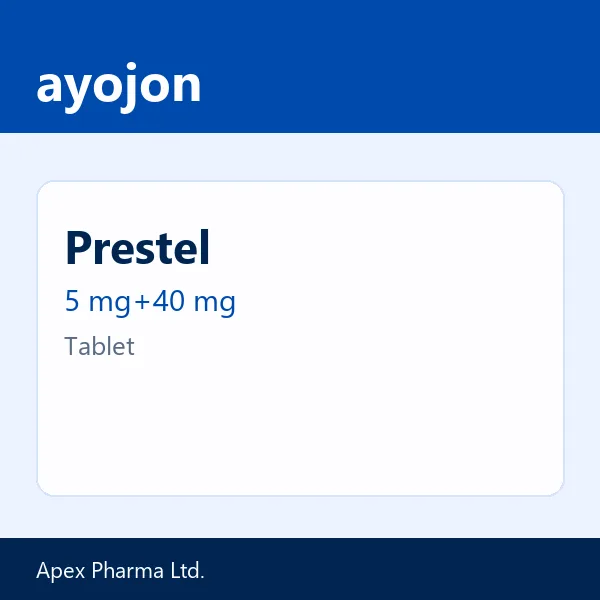


Generic: Amlodipine Besilate Telmisartan | Dosage Form: Tablet | Manufacturer: Apex Pharma Ltd.
Indications
This preparation is indicated for the treatment of hypertension, alone or with other antihypertensive agents. It may also be used as initial therapy in patients who are likely to need multiple drugs to achieve their blood pressure goals.
Dosage & Administration
Initial Therapy: Patient may be initiated on this tablets if it is unlikely that control of blood pressure would be achieved with a single agent. The usual starting dose is 40/5 mg once daily. Patients requiring larger blood pressure reductions may be started with 80/5 mg once daily. Initial therapy with this is not recommended in patients 575 years old or with hepatic impairment.
Add-on Therapy: Patients not adequately controlled with amiodipine (or another dihydropyridine calcium channel blocker) alone or with telmisartan (or another angiotensin receptor blocker) alone. Patients treated with 10 mg amiodipine who experience adverse reactions such as edema, may be switched to this 40/5 mg tablets once daily, reducing the dose of amiodipine without reducing the overall expected antihypertensive response.
Replacement Therapy: Patients receiving amiodipine and telmisartan from separate tablets may instead receive this tablets containing the same component doses once daily. Dosage must be individualized and may be increased after at least 2 weeks. The maximum recommended dose of this tablet is 80/10 mg once daily.
Interaction
Co-administration of telmisartan did not result in a clinically significant interaction with acetaminophen, amiodipine, glyburide, simvastatin, hydrochlorothiazide, warfarin, or ibuprofen. Telmisartan is not metabolized by the cytochrome P450 system and had no effects in vitro on cytochrome P450 enzymes, except for some inhibition of CYP2C19.
Telmisartan is not expected to interact with drugs that inhibit or are metabolized by cytochrome P450 enzymes, except for possible inhibition of the metabolism of drugs metabolized by CYP2C19.
In clinical trials, amiodipine has been safely administered with thiazide diuretics, beta-blockers, angiotensin converting enzyme inhibitors, long-acting nitrates, sublingual nitroglycerin, digoxin, warfarin, non-steroidal anti inflammatory drugs, antibiotics, and oral hypoglycemic drugs.
The following have no clinically relevant effects on the pharmacokinetics of amiodipine: cimetidine, grapefruit juice, sildenafil. Amiodipine has no clinically relevant effects on the pharmacokinetics or pharmacodynamics of the following: atorvastatin, digoxin, warfarin.
Contraindications
- Known hypersensitivity to this product or any of its components.
- Pregnancy & lactation.
- Biliary obstructive disorders, severe hepatic impairment, hypotension, cardiogenic shock, left ventricle outflow tract obstruction.
Side Effects
Dizziness, peripheral edema, migraine, headache, paraesthesia, vertigo, bradycardia, palpitations, hypotension, cough, abdominal pain, diarrhea, nausea, pruritus, myalgia, spasm, erectile dysfunction,chest pain, fatigue, edema etc.
Precautions & Warnings
- Avoid fetal or neonatal exposure
- Hypotension: Correct any volume or salt depletion before initiating therapy. Observe for signs and symptoms of hypotension
- Titrate slowly in patients with hepatic or severe renal impairment
- Heart failure: Monitor for worsening
- Avoid concomitant use of an ACE inhibitor and angiotensin receptor blocker
- Myocardial infarction: Uncommonly, initiating a CCB in patients with severe obstructive coronary artery disease may precipitate myocardial infarction or increased angina.
Overdose Effects
Telmisartan: Limited data are available with regard to overdosage in humans. The most likely manifestations of over dosage with telmisartan tablets would be hypotension, dizziness, and tachycardia; bradycardia could occur from parasympathetic (vagal) stimulation. If symptomatic hypotension should occur, supportive treatment should be instituted. Telmisartan is not removed by hemodialysis.
Amiodipine: Overdosage might be expected to cause excessive peripheral vasodilation with marked hypotension and possibly reflex tachycardia. If massive overdose occur, active cardiac and respiratory monitoring should be instituted. Frequent bipod pressure measurements are essential. If hypotension occur, cardiovascular support including elevation of the extremities and the judicious administration of fluids should be initiated. If hypotension remains unresponsive to these conservative measures, administration of vasopressors (such as phenylephrine) should be considered with attention to circulating volume and urine output. Amiodipine is not removed by hemodialysis.
Therapeutic Class
Combined antihypertensive preparations
Storage Conditions
Do not store above 30°C. Protect from light and high humidity. Keep out of the reach of children.