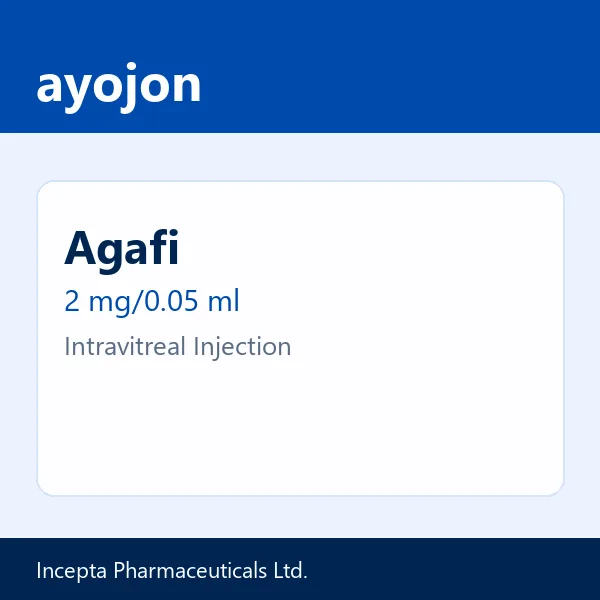


Generic: Aflibercept Intravitreal Injection | Dosage Form: Intravitreal Injection | Manufacturer: Incepta Pharmaceuticals Ltd.
Indications
Agafi Intravitreal Injection is indicated for adults for the treatment of-
- Neovascular (wet) age-related macular degeneration (AMD)
- Visual impairment due to macular oedema secondary to retinal vein occlusion (branch RVO or central RVO)
- Visual impairment due to diabetic macular oedema (DME)
- Visual impairment due to myopic choroidal neovascularisation (myopic CNV)
Dosage & Administration
Neovascular (Wet) Age-Related Macular Degeneration (AMD)-
- The recommended dose for Aflibercept is 2 mg (0.05 mL) administered by intravitreal injection every 4 weeks (approximately every 28 days, monthly) for the first 3 months, followed by 2 mg (0.05 mL) via intravitreal injection once every 8 weeks (2 months).
- Although Aflibercept may be dosed as frequently as 2 mg every 4 weeks (approximately every 25 days, monthly), additional efficacy was not demonstrated in most patients when Aflibercept was dosed every 4 weeks compared to every 8 weeks. Some patients may need every 4 weeks (monthly) dosing after the first 12 weeks (3 months).
- Although not as effective as the recommended every 8 weeks dosing regimen, patients may also be treated with one dose every 12 weeks after one year of effective therapy. Patients should be assessed regularly.
Macular Edema Following Retinal Vein Occlusion (RVO)-
- The recommended dose for Aflibercept is 2 mg (0.05 mL) administered by intravitreal injection once every 4 weeks (approximately every 25 days, monthly)
Diabetic Macular Edema (DME) and Diabetic Retinopathy (DR)-
- The recommended dose for Aflibercept is 2 mg (0.05 mL) administered by intravitreal injection every 4 weeks (approximately every 28 days, monthly) for the first 5 injections followed by 2 mg (0.05 mL) via intravitreal injection once every 8 weeks (2 months).
- Although Aflibercept may be dosed as frequently as 2 mg every 4 weeks (approximately every 25 days, monthly), additional efficacy was not demonstrated in most patients when Aflibercept was dosed every 4 weeks compared to every 8 weeks. Some patients may need every 4 weeks (monthly) dosing after the first 20 weeks (5 months).
Contraindications
Hypersensitivity to the active substance aflibercept or to any of the excipients Active or suspected ocular or periocular infection. Active severe intraocular inflammation.
Side Effects
The most common adverse reactions (≥5%) reported in patients receiving Aflibercept were conjunctival hemorrhage, eye pain, cataract, vitreous detachment, vitreous floaters, retinal pigment epithelial tear and intraocular pressure increased.
Precautions & Warnings
Endophthalmitis, retinal pigment epithelial tear and retinal detachments may occur following intravitreal injections. Patients should be instructed to report any symptoms suggestive of endophthalmitis or retinal detachment without delay and should be managed appropriately.
- Increases in intraocular pressure have been seen within 60 minutes of an intravitreal injection.
- There is a potential risk of arterial thromboembolic events following intravitreal use of VEGF inhibitors
Therapeutic Class
Other ophthalmic preparations
Storage Conditions
Store at 2ºC to 8ºC in a refrigerator. Do not freeze. Keep away from light and out of the reach of children.